Guess the Sound
 Funded by the European Union. Views and opinions expressed are however those of the author(s) only and do not necessarily reflect those of the European Union or the European Education and Culture Executive Agency (EACEA). Neither the European Union nor EACEA can be held responsible for them. |
 All contents, in particular texts, pictures and graphics, are protected by copyright. Unless expressly stated otherwise, copyright is held by sel.eduskills.plus and is licensed under Creative Commons Attribution - Non-commercial - Distribution under the same conditions 4.0 International license. They may be subject to the terms of the license. |
© 2026 sel.eduskills.plus
| Basic | |
| Age: 4-6 | |
| 20-30 min | |
| Children listen to different sounds, guess their source, and reflect on their listening experience to build focus, memory, and auditory awareness. | |
| Flexibility Self-regulation Critical thinking | |
| Cognitive task Conversation | |
|
Preparation
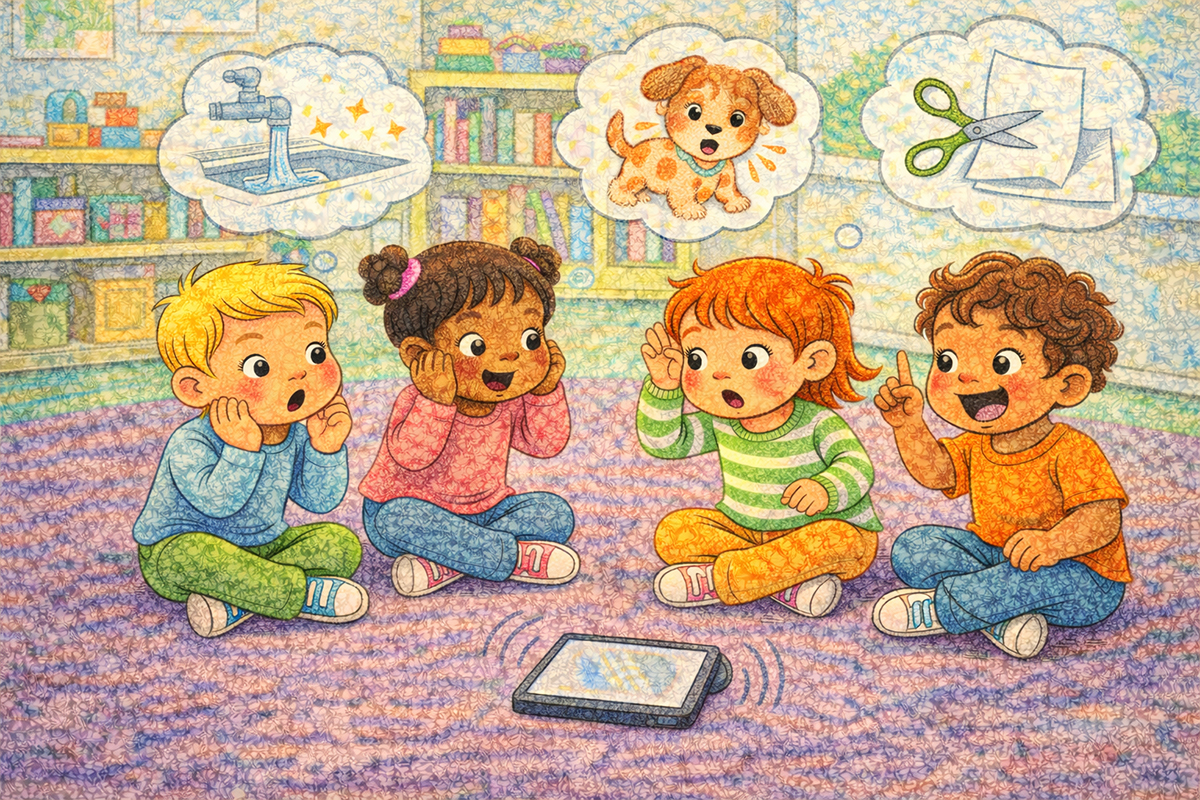
Prepare a device to play sounds (CD player, phone with speakers, or tablet). Gather different everyday sound, such as turning on a faucet, flushing the toilet, brushing teeth, zipping a zipper, using a blender, or cutting paper.
Implementation
Introduce the game with a short and playful listening routine to help children prepare their bodies and minds for focused attention:
"Let’s get ready to listen! Take a deep breath in... and out. Stretch your arms, sit comfortably. Now, close your mouth like it has a tiny lock on it, and give your ears a gentle rub to wake them up."
Explain that in this game, everyone will listen carefully to a mystery sound - and then try to guess what it is.
Play a sound using a sound carrier (such as a speaker or audio device). It might be a common household or nature sound, a musical instrument, or an everyday object.
Children sit quietly and listen with full attention while the sound plays. Once it ends, ask them: What do you think made that sound?
Encourage children to think aloud, share ideas, and help each other guess. They can describe what the sound reminds them of, how it made them feel, or where they’ve heard it before.
Reflection
You can ask questions:
- How did you feel while listening to the sounds?
- Was it fun? Was it easy or tricky to guess some sounds?
- Which sound did you like best?
This reflection helps children connect to their senses, focus, and emotions, while encouraging communication and group learning.
Variations and Additional Ideas
Animal Sounds
Play recordings of different animal sounds and have the children guess which animal made the sound.
Transportation Sounds
Use sounds of vehicles such as cars, trains, planes, or bicycles. Children try to identify the type of transport.
Child-Made Sounds
Let one child make a sound using an object (or their voice), while the others guess what it was. This variation encourages creativity and group interaction.
Sound Memory
Play a sequence of sounds and repeat one from earlier. Children listen carefully to identify when a sound is repeated.
Sound and Picture Match
Provide picture cards of familiar things (e.g. a cow, a drum, a bell). Children match the sound they hear to the correct image.
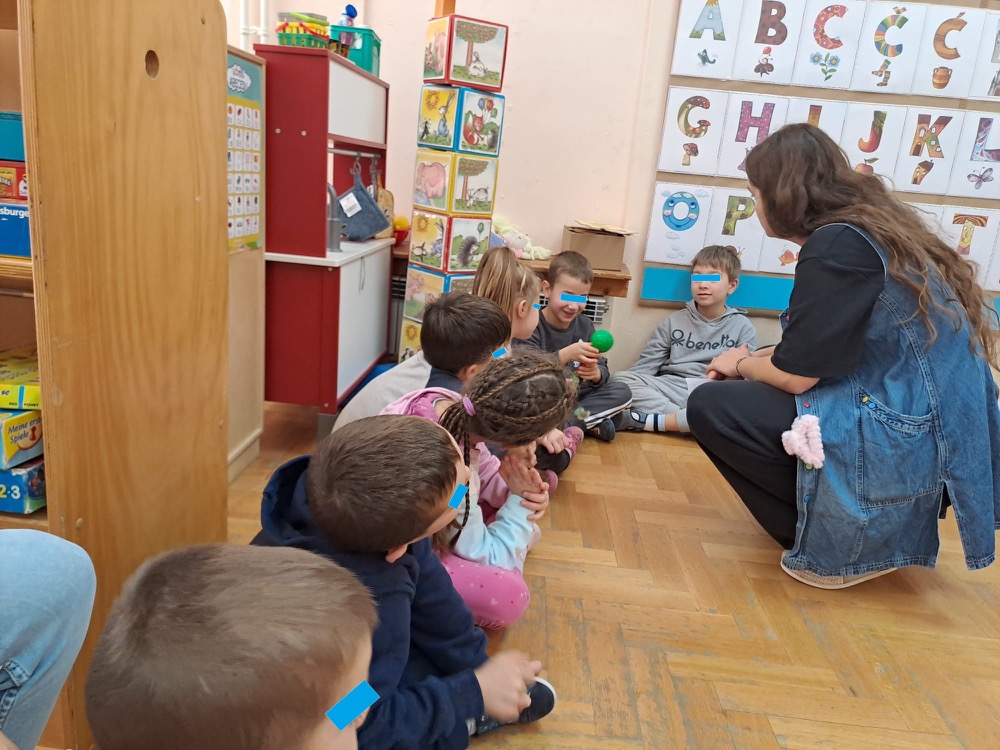
Photos of the Activity