| Basic | |
| Age: 4-6 | |
| 20-30 min | |
| Children become aware of their emotional states through body stillness and movement. Guided by Miro and Kira, they practice self-regulation playfully. | |
| Self-regulation | |
| Flexibility Wellbeing Critical thinking | |
| Cognitive task Movement Outdoors | |
|
Be aware of children who might not respond well to this exercise (e.g. autism spectrum, ADHD, “late bloomers” etc.). Do not force children to take part at any time.
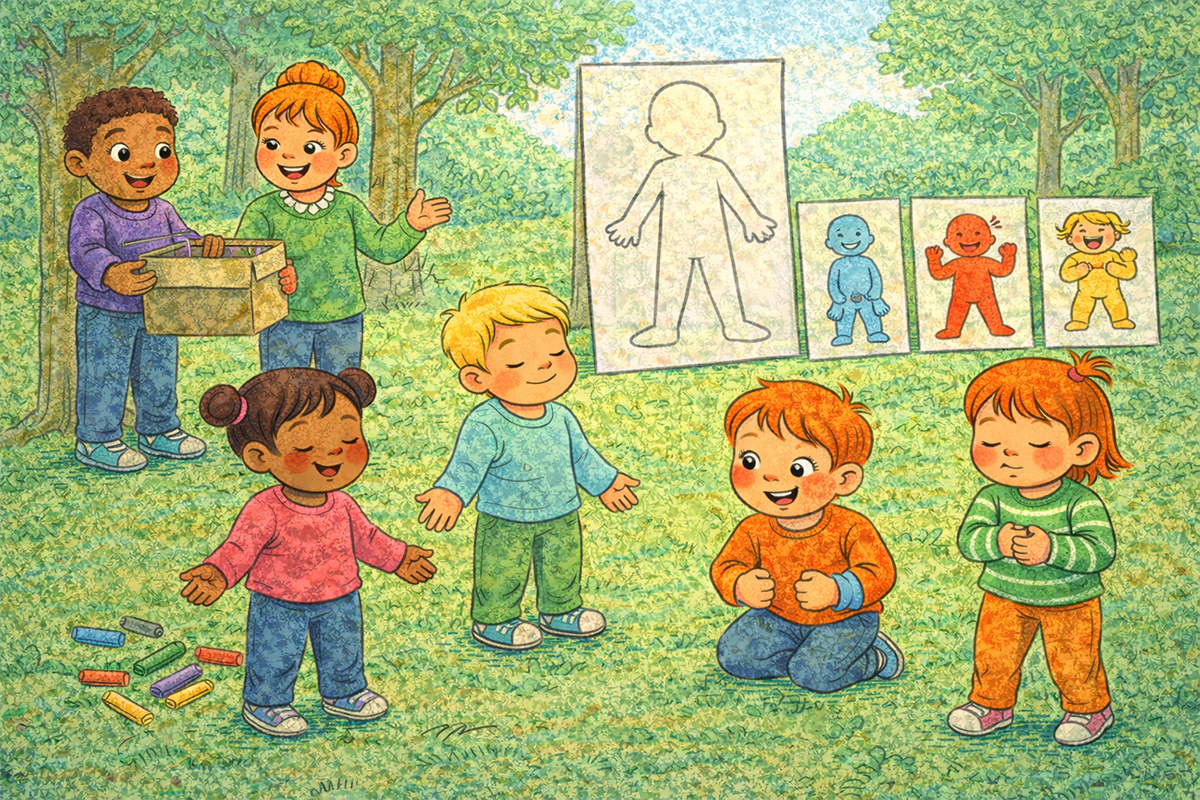
Miro and Kira appear with the magic box and tell the children they’ve discovered something special inside - a new game called the Stop Game. They explain that this is a game where we practice freezing like statues and learning to listen to our bodies and feelings.
Kira, the curious one, asks: “What happens when we stand really still? Can we hear or feel something we didn’t notice before?”
Miro adds gently: “Let’s try it together. I’ll show you how.”
They demonstrate the freeze position and introduce the idea of listening to their breathing, their body parts, and their feelings.
Explain that when the teacher (or puppet) says “Stop!”, everyone freezes like a statue for about one minute. During this time, Miro or Kira will gently guide the group through a series of relaxing body and awareness prompts.
Use a calm, soothing voice and leave pauses between each instruction:
Then, Miro softly says: “Get ready... and... go!”
Children can defrost, shake themselves out, laugh, and return to what they were doing before.
Repeat the game a few times during the session, letting different children suggest when to start or stop.
After the activity, ask open questions to encourage reflection:
Encourage children to describe their experiences using body words or emotions (e.g., “My legs were tired.”, “It felt calm.”, “I felt wiggly inside”).
The “Stop” routine can also be used in individual moments with a child in conflict. When a child is feeling overwhelmed, use the familiar commands to help them pause and reconnect with their body and emotions:
Important: Only use this in challenging situations if the child has already experienced the Stop Game as a safe and playful activity. You should feel connected and ready to offer calm, steady support.
Avoid using the technique during intense emotional outbursts (e.g., tantrums) if you're not fully prepared to hold space for the child.
During the freeze moment, ask children to name a color that matches how they feel. They can then color it on a human body outline, describe physical sensations, or share any thoughts or images that come to mind. This builds awareness of how emotions connect to the body.
Introduce the Stop Game routine at a parent meeting. Walk parents through the activity step-by-step so they can experience its calming effect firsthand. Start a discussion about why it works, and how parents might support emotional regulation at home using simple, playful tools like this.

Funded by the European Union. Views and opinions expressed are however those of the author(s) only and do not necessarily reflect those of the European Union or the European Education and Culture Executive Agency (EACEA). Neither the European Union nor EACEA can be held responsible for them.

All contents, in particular texts, pictures and graphics, are protected by copyright. Unless expressly stated otherwise, copyright is held by sel.eduskills.plus and is licensed under Creative Commons Attribution - Non-commercial - Distribution under the same conditions 4.0 International license. They may be subject to the terms of the license.
© 2024-2026 sel.eduskills.plus | Impressum