
You already know it: Social, emotional, and "learning to learn" (so-called metacognitive learning) are not just pedagogical buzzwords - they are the foundation for successful development and harmonious everyday life with children.
With this project, you intentionally place these topics at the center of your pedagogical work.
And yes - you're probably already very familiar with the following core principles. But because they are so important to us, they appear right at the beginning of the introduction as a reminder. They are the common thread that holds everything together.
Placing the child at the center and aligning decisions with their well-being is a cornerstone of early childhood education and care.
This means: Every attitude, every measure, and every activity that concerns children should support their safety, well-being, and development.
This principle is not only pedagogically and ethically sound, but also anchored in Article 3 of the UN Convention on the Rights of the Child, which has been ratified by all EU member states and emphasizes the best interests and participation rights of children.
When you use the child's well-being as your compass, you create a space in which children feel safe, seen, respected, and empowered.
The project supports you with tried-and-tested methods to accompany each child individually and sensitively in a caring and developmentally supportive learning environment.
Appreciative engagement with diversity is essential. Children should develop pride in their own identity and, at the same time, learn to respect and understand others in their differences.
With the anti-bias approach, we reflect on our own unconscious biases in order to evolve, embrace diversity more fully, prevent exclusion, and enable genuine participation for all children. It all begins with our attitude: open, curious, and reflective. We look at our environment differently and pay increasing attention, for example, to using materials in which as many children as possible can see themselves - without clichés, without one-sidedness.
In the activities, you'll find carefully selected stories, images, and materials that reflect the diversity of family structures, cultural backgrounds, and life realities.
Social and emotional learning does not stop at the center's door.
Actively involve parents - with small take-home ideas, invitations to explore stories or activities together, or with parent evenings that convey SEL topics in a hands-on way.
When early childhood educators and parents work together, a strong bridge is built between home and daycare and that gives children orientation, security, and support.
For your introduction to SEL practice, two main components are available:
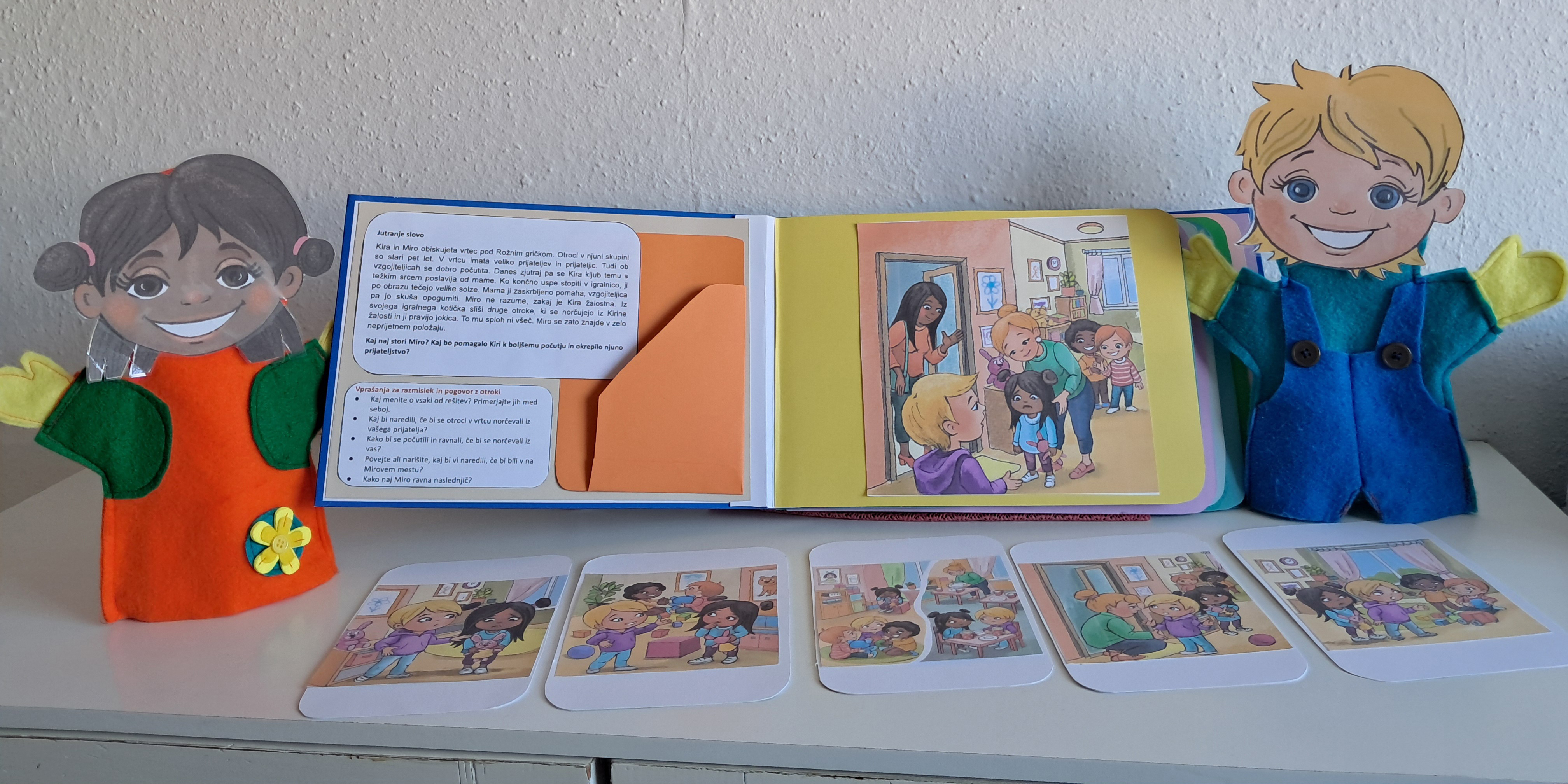
Our booklet supports you in integrating SEL (Social and Emotional Learning) into everyday kindergarten life in a situational, child-centered, and playful way. The stories address central themes such as friendship, empathy, diversity, and collaborative problem-solving — engaging, age-appropriate, and closely connected to children’s real-world experiences.
Through listening, storytelling, discussion, and role-play, children strengthen their social relationships, learn to understand and express emotions, and develop confidence in managing everyday challenges. The stories can be enriched with materials such as hand puppets, picture cards, and play ideas that stimulate imagination, bring the content to life, and encourage active participation.
A particular focus of the booklet is L2 – Learning to Learn (Critical Thinking) as the main competence area. The activities and stories support children in developing self-awareness, reflection, curiosity, and independent learning strategies, while also fostering important personal and social learning competencies through cooperation, communication, empathy, and shared experiences.
Instructions for Making a Puppet
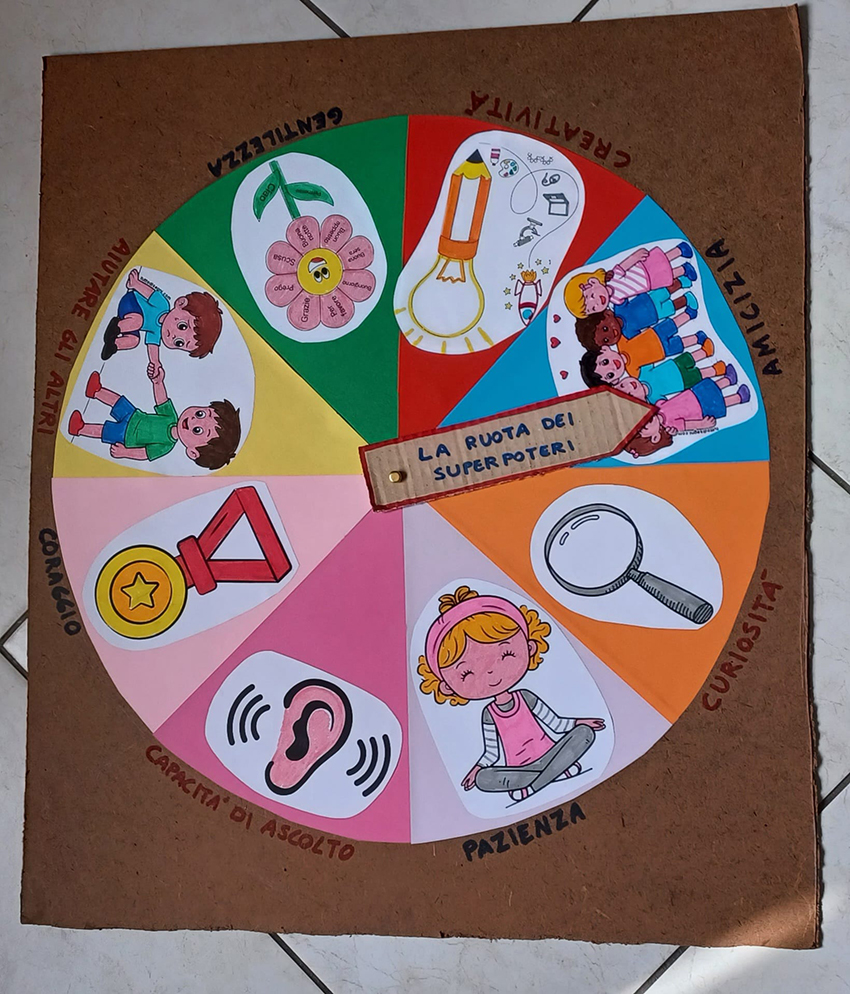
All foundation and advanced activities offer various formats - playful exercises, role-plays, or targeted, child-friendly SEL techniques. Or you might launch into a project that spans multiple sessions.
Projects are particularly well suited to anchor SEL topics in daily life and make them personally meaningful for children.
Make SEL an experience in participation. You hold the overview of the methods - and you know the children in your group. Involve them actively in the process and let them choose among ideas. Let's be honest: not everything we adults find useful automatically appeals to children. Be open to what unfolds when you follow the children's ideas.
All activities are flexible: you can adapt them to your group's current stage, leave out individual elements, or rearrange them as needed.
Each activity stands on its own, is clearly structured, and marked with symbols - making it easy for you to navigate and plan effectively.
With each new activity, SEL becomes a more natural part of your educational routine - tangible, impactful, and full of life.
You can start right away with the full sequence, which includes all activities and prompts. Alternatively, you can use our example sequence to introduce SEL step by step into your daily educational practice.
This example sequence is intended as inspiration. You can always adjust the order, pace, and focus areas to match the needs and interests of your children. Some of the most meaningful learning moments often happen when children are especially engaged and a topic can be explored in greater depth together.
Step by step, the suggested activities can help build important SEL experiences and supportive routines that grow naturally and sustainably over several months. Afterwards, you can easily switch to the advanced activities included in the full program.
Phases of the example sequence and suggested approximate duration:
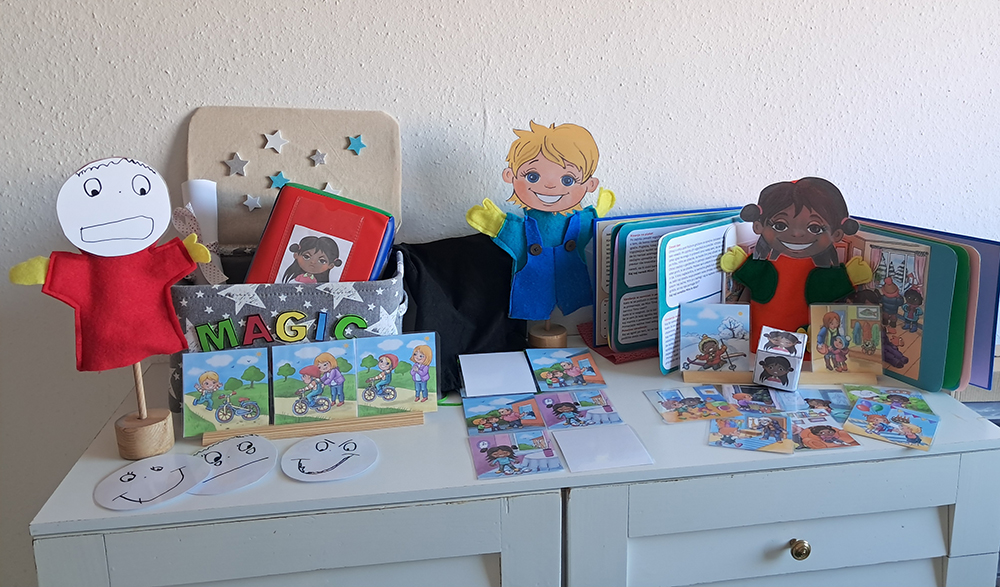
Some activities are especially suited for embedding into small puppet scenes - and who better than Kira and Miro to lead the way? They introduce the activity - ideally with the Magic Box. It's a multi-talented pedagogical tool. Inside are materials that kick off the topic in an exciting way. This has impact - motivating, engaging, and with a pinch of magic.
To make everything flow smoothly, we recommend the SEL three-phase structure:
During shared social-emotional learning (SEL) activities, children may express intense emotions such as joy, anger, sadness, fear, or frustration very strongly. These situations are a normal part of everyday pedagogical practice, offer important learning opportunities, and require attentive and professional guidance. Early childhood educators provide safety in these moments, take children’s feelings seriously, and support them in recognizing, naming, and gradually regulating their emotions. A key principle is a flexible, child-centered approach in which the planned structure is adjusted according to the current group situation.
Equally important is educators’ self-regulation and self-reflection. Their own emotional reactions such as uncertainty, anger, overwhelm, or helplessness should be consciously noticed and reflected upon, as they can influence professional practice. Regular team exchange and collegial consultation support educators in making sense of challenging situations and continuously developing their pedagogical approach.
This stance helps to understand strong emotions not as a disruption, but as an integral part of early childhood development and as meaningful opportunities for learning.
Because emotions are closely linked to bodily processes, the body can be used as a central access point for emotion regulation. In highly emotional moments, it is often no longer possible to address situations calmly through conversation. Through the body, children can be supported in a targeted way by first expressing strong internal arousal, then structuring it, and finally calming down. Educators should have a high level of methodological confidence and, when offering body-oriented impulses, respond sensitively to children’s reactions and adapt activities accordingly.
Examples:
The foundation activities lay the groundwork. The advanced activities are available to you flexibly. With them, children deepen their knowledge, practice constructive emotional management, improve self-regulation, develop social skills, dive further into learning to learn, and grow even stronger as a group.
Use your growing experience and confidence with the methods to choose what suits your group - always together with the children, of course.
With your attitude, your knowledge, and your commitment to the children, SEL comes to life. The methods and materials offer inspiration - but they only unfold their full impact through you. You guide children to feel safe and confident, to understand themselves and others better, to shape relationships, and to grow with optimism.
We wish you and the children an enriching journey - with hands, heart, mind, and lots of joy.

Funded by the European Union. Views and opinions expressed are however those of the author(s) only and do not necessarily reflect those of the European Union or the European Education and Culture Executive Agency (EACEA). Neither the European Union nor EACEA can be held responsible for them.

All contents, in particular texts, pictures and graphics, are protected by copyright. Unless expressly stated otherwise, copyright is held by sel.eduskills.plus and is licensed under Creative Commons Attribution - Non-commercial - Distribution under the same conditions 4.0 International license. They may be subject to the terms of the license.
© 2024-2026 sel.eduskills.plus | Impressum